













Best for: Freelancers and side hustlers who want to earn $60-150/hr building no-code automations for small businesses using Make.com, Zapier, or n8n. No coding required.
Not ideal for: People looking for fully passive income (automation services require active client management and builds) or anyone targeting enterprise consulting out of the gate (start local and small, scale later).
Most people hear “freelance AI work” and picture prompt engineering gigs on Fiverr paying $15 for a pack of 100 prompts. That’s not what this is.
There’s a specific opportunity sitting wide open in 2026 that most people haven’t found yet because it doesn’t look glamorous and it isn’t being hyped on YouTube. It’s selling automation services to small and medium businesses using tools like Make.com, Zapier, and n8n. The businesses that need this are everywhere. The people who can deliver it are not.
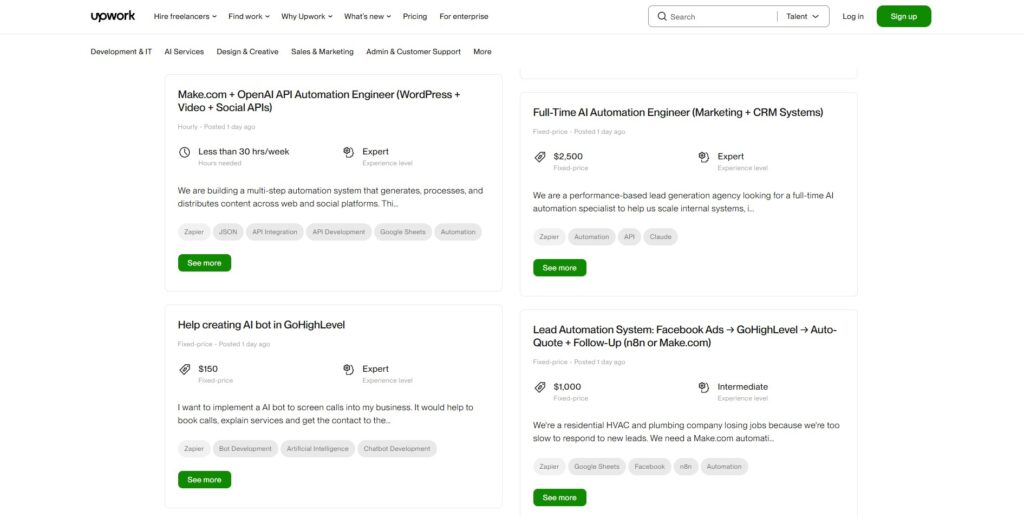
Upwork data from early 2026 puts AI automation freelancers at $60 to $150 per hour depending on complexity and niche. That’s not a ceiling. Specialists with documented case studies in specific industries are charging more. And unlike content creation or social media management, automation work has a natural recurring revenue component built in. You build it once, you maintain it monthly, the client pays you both times.
Why AI Automation Services Are in Demand (2026)
Small businesses are in an awkward position with AI in 2026. They know they’re supposed to be using it. They’ve read the articles, seen the LinkedIn posts, watched their competitors mention it. But the gap between “I should be using AI” and “I know how to actually implement something useful” is enormous for a business owner whose expertise is running a dental practice or a landscaping company, not evaluating automation platforms.
They need someone to bridge that gap. They’ll pay for it. And right now there aren’t enough people who can do it confidently and deliver real results.
The window for this advantage won’t stay open forever. As tools get easier and more businesses figure out DIY implementation the opportunity narrows. The freelancers building track records and case studies right now are going to have a significant head start on everyone who waits six months to get started.
What AI Automation Services Actually Look Like
The service isn’t “I’ll set up Make.com for you.” Nobody wants to buy that. The service is an outcome.
“I’ll build a system that automatically moves every new lead from your website into your CRM, sends them a welcome email sequence, and notifies your sales team on Slack all within 60 seconds of them submitting the form. No more manual data entry, no more leads falling through the cracks.”
That’s what you’re selling. The technology is Make.com. The product is never losing a lead again.
The most in-demand automation services for small businesses right now based on what’s actually selling on freelance platforms:
Lead capture and CRM automation — new form submissions routed automatically to CRM, email sequence triggered, team notified. Every business with a website needs this and most are still doing it manually.
Appointment and booking automation — confirmation emails, reminder sequences, follow-up messages, calendar syncing. Service businesses like salons, consultants, and healthcare practices are the sweet spot.
Invoice and payment follow-up — automatic reminders when invoices are overdue, payment confirmation emails, bookkeeping updates. Any business that invoices clients manually is leaving time on the table.
Social media scheduling automation — content pulled from a database or Google Sheet and posted on a schedule across platforms. Marketing agencies and content-heavy businesses pay well for this.
Reporting and analytics automation — data pulled from multiple sources, formatted, and delivered to stakeholders on a schedule. Operations managers and agency owners who hate assembling weekly reports manually are your clients. For the more technical end of this, tools like OpenClaw can handle the same kinds of tasks autonomously through messaging apps, though the setup requires terminal comfort your typical small business client won’t have.
If you want to go from zero to actually selling automations, this is the most complete free resource I’ve found. You don’t need to watch it all at once — bookmark it and work through it as you build your first workflows.
AI Automation Pricing: What to Charge Small Businesses
| Service Package | Price | Build Time | Example |
|---|---|---|---|
| Simple Automation | $300-500 | 2-3 hours | Form → CRM → welcome email |
| Complex Workflow | $800-1,500 | 6-10 hours | Multi-branch with error handling and integrations |
| Full Audit + Implementation | $2,000-3,500 | 15-25 hours | Operations audit, top 3 automations built and tested |
| Monthly Retainer | $100-300/mo | 2-4 hrs/mo | Monitoring, fixes, minor updates, new requests |
To be more specific about what each tier actually includes, since this is where most beginners undercharge or overpromise:
The simple automation ($300-500) is a single workflow with 3-5 steps. Form submission triggers a CRM entry, sends a confirmation email, and notifies the team. You build it, test it with 10 sample submissions, record a 2-minute walkthrough, and hand it over. Total time: one afternoon. Total cost to you: $0 if you’re on Make.com’s free tier.
The complex workflow ($800-1,500) involves branching logic, multiple integrations, and error handling. A lead comes in, gets scored based on form answers, routes to different team members based on score, triggers different email sequences based on the routing, and logs everything in a Google Sheet for reporting. This is where Make.com’s visual canvas earns its keep. You can see the entire flow on one screen and so can the client during your handoff call.
The full audit ($2,000-3,500) is the premium play. You spend 2-3 hours mapping the client’s current manual processes, identify the top 3-5 automation opportunities ranked by time saved, build and test the top 3, document everything, and train their team. This is consulting plus implementation. The audit alone is worth $500 to most business owners because they’ve never had someone map their operations this way.
The mistake most beginners make is charging by the hour from day one. Hourly billing caps your earnings at your speed and punishes you for getting better at the work. Price by the project instead.
A simple three-step automation, something like form to CRM to email, is worth $300 to $500 as a fixed project. It might take you two hours to build. That’s $150 to $250 per hour without billing hourly. A complex multi-branch workflow with multiple integrations and error handling is worth $800 to $1,500. A full automation audit of a business’s operations plus implementation of the top three opportunities is worth $2,000 to $3,500.
Monthly retainers are where the income compounds. Charge $100 to $300 per month per client for maintenance, monitoring, and minor updates. Ten clients on $200 retainers is $2,000 a month of recurring revenue that largely runs itself once the systems are stable.
The framing that works: “The setup fee covers the build and testing. The retainer covers you. If anything breaks, I fix it. If you want to add something new, we talk about it. You’re never left dealing with a broken workflow on your own.”
How to Find Your First AI Automation Client
The chicken and egg problem of freelancing: clients want experience, you need clients to get experience. Here’s how to break it.
Build two or three demo automations for hypothetical businesses before you reach out to anyone. A lead capture system for a fictional law firm. An appointment reminder sequence for a fictional dental practice. Document them with screenshots, record a two-minute Loom video walking through how each one works. That’s your portfolio. It’s not work you did for a client but it demonstrates you know what you’re doing.
Then pick one industry and own it. Don’t be a generalist who automates anything for anyone. Be the person who automates operations for dental practices. Or law firms. Or real estate agencies. Or e-commerce brands. Specialization makes you easier to find, easier to trust, and easier to refer. “I know a guy who does automation specifically for dental practices” is a referral that actually happens. “I know a guy who does automation” is too vague to refer.
Find your first client through direct outreach to your chosen niche. LinkedIn is the best channel for professional service businesses. Local Facebook groups work for genuinely local businesses. Industry-specific forums and subreddits are underused and often have business owners actively asking for help with exactly what you’re offering.
The pitch that works: be specific about the problem, specific about the solution, and specific about what it costs. Vague pitches get ignored. “I noticed most dental practices manually enter new patient inquiries into their systems. I build automations that handle that automatically and save front desk staff about two hours a day. I’ve built a demo for a fictional practice if you want to see what it looks like. Takes 15 minutes.”
What Your AI Automation Proposal Should Look Like
You don’t need a fancy proposal template. A clean Google Doc with five sections is enough to close most small business deals:
Section 1: The Problem. One paragraph naming their specific pain point. “Your team manually enters every new patient inquiry into Dentrix, which takes 15-20 minutes per day and occasionally leads to missed follow-ups.”
Section 2: The Solution. What the automation does in plain English. “I’ll build a system that automatically captures every inquiry from your website form, creates a new patient record in Dentrix, sends the patient a confirmation email, and sends your front desk a Slack message. All within 60 seconds of the form submission.”
Section 3: What’s Included. Exactly what you’ll deliver. The workflow, testing with sample data, a walkthrough video, and one revision round.
Section 4: Pricing. Project fee + optional retainer. “$800 for the build. $200/month for ongoing monitoring and updates.”
Section 5: Timeline. “Build takes 5-7 business days. Handoff call scheduled for the following week.”
That’s it. Keep it under one page. Business owners don’t read long proposals. They read short ones that make the next step obvious. End with “Reply ‘yes’ and I’ll send the invoice.”
Building the Skills to Sell AI Automation
You don’t need to be an expert before you start. You need to be competent enough to deliver what you promise and honest enough not to promise what you can’t deliver yet.
If you’re not sure which platform to learn first, we did a full comparison of Make.com vs Zapier vs n8n that breaks down exactly which one fits which use case. Make.com has free tutorials and a full Academy that covers everything from basic scenarios to complex multi branch workflows. Spend two focused weekends going through it. Build the demo automations. Break things deliberately so you understand what error handling looks like. By the end of weekend two you’ll know more about Make.com than 95% of the small business owners you’ll be pitching.
The tools you actually need to learn to start: Make.com or Zapier for the workflow layer, basic understanding of webhooks and APIs so you can connect anything that isn’t natively supported, and whatever CRM and email tools are dominant in your chosen niche. If you’re targeting dental practices, learn how Dentrix or Eaglesoft works. If you’re targeting e commerce brands, learn Shopify’s data structure. Niche knowledge plus automation skills is the combination that commands the higher end of that $60 to $150 per hour range.
What a Typical Week Looks Like Selling AI Automation
Here’s a realistic week once you’re 2-3 months in with a few clients and active outreach:
Monday: Check in on 3 retainer clients. Review error logs on their Make.com scenarios. One workflow failed over the weekend because the client changed a field name in their CRM. Fix it in 10 minutes. Send a quick update. Total: 45 minutes.
Tuesday: Discovery call with a potential client, a real estate agency that wants their lead follow-up automated. Walk through their current process, identify 3 pain points, quote $1,200 for the build and $200/month retainer. Total: 1 hour.
Wednesday: Build day. Spend 4 hours constructing the real estate agency’s lead capture workflow. Form submission to HubSpot to email sequence to Slack notification with conditional routing based on property interest type. Test with 15 sample leads.
Thursday: Finish build, record a walkthrough video for the client, schedule handoff call for Friday. Spend 1 hour on LinkedIn outreach to 10 dental practices. Two respond. Total: 2 hours.
Friday: 30-minute handoff call with real estate agency. They’re impressed. They ask if you can also automate their showing confirmation emails. Quote $400 as an add-on. They say yes.
Total week: about 12 hours of actual work. Revenue: $1,200 new project + $400 add-on + $600 retainer income from existing clients = $2,200. Not bad for three days of real work.
The Honest Timeline for AI Automation Income
First client: two to four weeks if you’re actively outreaching. First retainer client: one to two months. Monthly recurring revenue of $1,000: three to six months with consistent effort. Monthly recurring revenue of $3,000 to $5,000: six to twelve months once you’ve niched down and have referrals coming in.
These aren’t guaranteed outcomes. They’re realistic ranges based on what people who’ve actually done this report. The variables are how specific your niche is, how good your outreach is, and how well you deliver for your first few clients. Get those three things right and the timeline compresses. Get them wrong and it drags out.
You can also bundle automation services with custom AI bot building, which is a natural upsell once a client sees what automation can do for their business. And if you want to turn your best workflows into products you sell repeatedly instead of building from scratch every time, we covered exactly how to do that in our guide to AI digital products.
The opportunity is real. The tools are accessible. The demand is documented. What’s missing for most people is just the decision to start.
AI Automation Services FAQ: Pricing, Skills and Clients
Current market rates for AI automation freelancers range from $60 to $150 per hour. Project-based pricing is more common and more profitable: $300 to $500 for a simple 3-step automation, $800 to $1,500 for complex multi-branch workflows, and $2,000 to $3,500 for a full operations audit plus implementation. Monthly retainers for monitoring and updates run $100 to $300 per client.
Make.com or Zapier for building the automations (both are visual, no-code tools), basic understanding of webhooks and APIs for connecting tools that don’t have native integrations, and Loom for recording client walkthrough videos. Make.com is the most cost-effective for complex workflows. Zapier has the most app integrations. n8n is free and open source for self-hosting. Most freelancers start with Make.com.
No. Make.com and Zapier are visual drag-and-drop platforms that require zero coding. Understanding basic concepts like triggers, actions, and conditional logic is enough to build most small business automations. The technical bar is significantly lower than building AI chatbots or developing software. Two focused weekends of learning is enough to start delivering real client work.
Pick one industry (dental practices, real estate, e-commerce) and do direct outreach via LinkedIn or cold email with a specific problem and solution. Build demo automations for hypothetical businesses to use as portfolio pieces before you reach out. Industry-specific subreddits and Facebook groups are underused channels where business owners actively ask for help with exactly what you offer. Avoid Fiverr where pricing races to the bottom.
AI bots are conversational interfaces that answer questions and interact with customers (built with tools like GPT Builder or CustomGPT). Automation services connect apps and workflows so tasks happen automatically without human intervention (built with tools like Make.com or Zapier). Many freelancers offer both: the bot handles the customer-facing interaction and the automation handles what happens behind the scenes after the bot collects the information.
Yes. At $300 to $1,500 per project and a few hours per build, two to three projects per month adds $1,500 to $3,000 to your income. The real compounding happens with monthly retainers. Ten clients on $200 per month retainers generates $2,000 in recurring revenue that requires only 2 to 4 hours per month of maintenance per client. Most successful automation freelancers started as a side hustle before scaling.