













Best for: Side hustlers and creators who want to build once and sell repeatedly, using AI to compress product creation from weeks to a weekend.
Not ideal for: People expecting instant passive income with zero marketing effort. Building the product is the easy part. Distribution is the real work.
Everyone wants passive income. Most people who try to build it give up before it works because they picked the wrong model, built the wrong product, or expected results too fast.
AI changes the math on digital products in a real way. Not because it makes passive income effortless — nothing does — but because it dramatically reduces the time and cost it takes to build something worth selling. What used to take weeks of writing, designing, and testing can now take a focused weekend. The distribution platforms already exist. The demand is already there. The gap between idea and revenue has never been smaller.
Here’s the honest guide to making it work.
What AI Digital Products Actually Are
A digital product is anything you create once and sell repeatedly without making another copy. An ebook. A template. A prompt pack. A Notion workspace. A Make.com automation blueprint. A custom GPT trained for a specific use case. A mini-course. A resource library.
The economics are genuinely different from service work. When you build a bot for a client you get paid once for that project. When you build a template or a tool that solves the same problem, you get paid every time someone buys it. The work is front loaded. The revenue isn’t.
AI accelerates the front-loaded work dramatically. A well-researched ebook that might have taken six weeks to write can be researched, outlined, drafted, and polished in a focused week using Claude or ChatGPT as your writing partner. A Notion template that might have taken a weekend to design can be built in an afternoon. A prompt pack that might have taken months of trial and error to develop can be tested and refined in days.
The result is you can build more products faster, test which ones resonate, and double down on what sells — without the grinding timeline that killed most digital product businesses before AI existed.
AI Digital Products That Sell in 2026
| Product Type | Build Time | Price Range | Competition |
|---|---|---|---|
| Niche prompt packs | 1-3 days | $17-47 | Medium (specificity wins) |
| Automation blueprints | 1-2 weekends | $27-97 | Low |
| Custom GPTs | 1 weekend | $27-67 | Growing |
| Notion/Airtable templates | 1-2 days | $17-97 | High |
| Mini-courses | 2-4 weekends | $47-197 | Medium |
Not all digital products are equal. The market in 2026 has clear winners and clear losers and knowing the difference saves you months of building something nobody wants.
What’s working:
Niche prompt packs and AI workflow templates. Not generic “1000 ChatGPT prompts” — that market is completely saturated and buyers know it’s worthless. Specific, tested prompt systems for specific use cases. A prompt pack for real estate agents to write listing descriptions. A system for therapists to write intake emails. A workflow for freelance designers to handle client communication. Specificity is everything. The more specific the problem you solve, the less competition you have and the more someone will pay.
Make.com and Zapier automation blueprints. You build a complex multi step workflow that solves a common business problem, document it thoroughly, and sell the blueprint. If you’d rather sell the service of building these workflows instead of the blueprint itself, our guide to selling AI automation services covers the pricing and client acquisition side. Buyers import it into their own account and have a working automation in minutes instead of hours. If you’re not sure which platform to build on, we did a full comparison of Make.com vs Zapier vs n8n that breaks down exactly which one fits which use case. These sell well on Gumroad, Etsy, and directly through your own site. Prices range from $17 to $97 depending on complexity.
Custom GPTs for specific industries. Build a GPT trained on a specific domain — a customer service bot configured for e-commerce returns, a legal document drafting assistant for freelancers, a content calendar generator for a specific niche. Sell access or sell the configuration files. Early movers in specific verticals are doing well here.
Notion and Airtable templates with AI integration. Workspace templates that include pre-built AI workflows, prompt libraries, and automation triggers. The combination of a good template with AI instructions built in commands prices of $27 to $197 depending on depth.
What isn’t working:
Generic prompt packs with no clear use case. AI writing “courses” from people who’ve never actually built a writing business. Dropshipping “powered by AI” — the AI label doesn’t fix the underlying dropshipping problems. Content farm websites — Google is getting better at detecting and devaluing them fast.
How to Build Your First AI Digital Product
Pick one problem you understand. Not a problem you think exists — a problem you’ve personally experienced or observed in detail. The more specific the better.
If you’ve worked in marketing, build a prompt system for marketing teams. If you’ve worked in real estate, build an automation blueprint for real estate agents. If you’re a freelancer, build a client onboarding workflow template. Your existing knowledge is the unfair advantage that makes your product better than something built by someone who just Googled the industry.
Then use AI to accelerate the build. Claude is particularly good for research, structuring complex documents, and writing instructional content. Midjourney handles visual assets. Canva Pro with AI features handles design. You’re not outsourcing the product to AI, you’re using AI to execute your vision faster.
Document everything as you build. The documentation becomes the product. A Make.com blueprint without explanation is just a file. A Make.com blueprint with a clear setup guide, a walkthrough video, troubleshooting tips, and real use case examples is a product worth $47 to $97.
Test it yourself before you sell it. Build it, use it, break it, fix it. A product you’ve actually tested is qualitatively different from one you built theoretically and it shows in the reviews.
Best Tools for Building AI Digital Products
You don’t need many tools. You need the right ones for each layer of the product.
For writing and research: Claude handles long-form content, research synthesis, and product documentation better than anything else right now. Use it for ebook drafts, course scripts, template instructions, and troubleshooting guides. ChatGPT is faster for shorter content and brainstorming. Use both.
For visual assets: Midjourney generates product mockups, cover images, and marketing visuals. Canva Pro handles layouts, social graphics, and anything that needs to look polished without a designer. Between the two you can produce professional-looking product assets in an afternoon.
For automation blueprints: Make.com is the platform to build on if you’re selling automation products. The visual canvas makes it easy to screenshot and document workflows. Export your scenario as a blueprint file, package it with a setup guide, and that’s your product.
For delivery and hosting: Gumroad handles everything. Upload your files, set a price, write the description. When someone buys, Gumroad delivers the files automatically. You never touch the transaction. For larger products like courses, Teachable or Podia handle video hosting and drip content.
Total tool cost to get started: $20/month for Claude Pro + $0 for Gumroad + whatever you’re already paying for Canva. Under $30/month to run a digital products business.
Where to Sell AI Digital Products
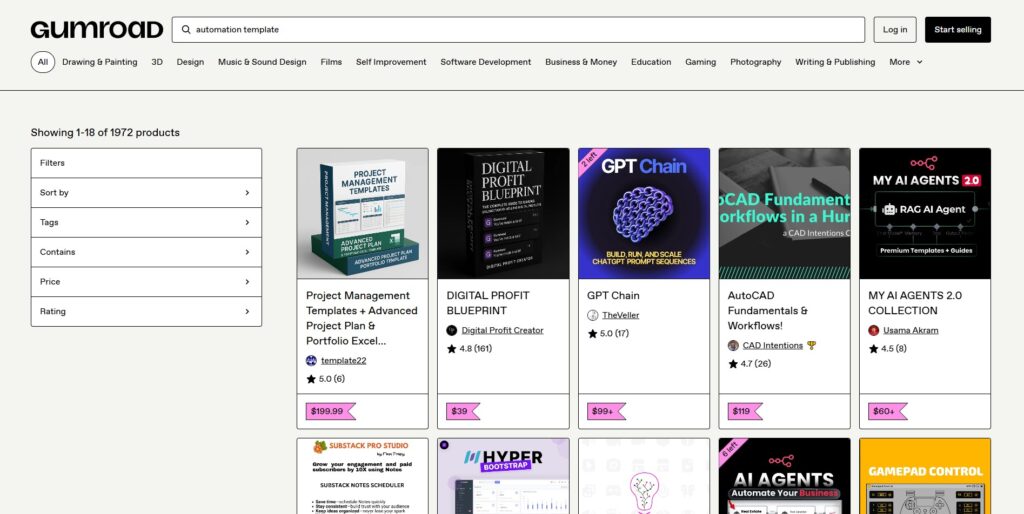
Gumroad is the default starting point. Zero upfront cost, takes a percentage of sales, massive built-in discovery for digital products. Easy to set up, easy to update, handles delivery automatically.
Etsy is underrated for digital products. Millions of buyers already on the platform looking for templates, planners, and tools. The AI template category specifically has been growing fast. Competition exists but it’s beatable with good SEO on your listing.
Your own site — meaning VirtualUncle for you — is the highest margin option once you have traffic. No platform fees, full control, builds your brand. The downside is you need to drive your own traffic which is why starting on Gumroad or Etsy first makes sense.
Payhip and Lemon Squeezy are solid Gumroad alternatives with slightly better fee structures at scale. Worth knowing about once you’re doing real volume.
AI Digital Product Pricing: The Math That Changes Everything
Most first-time digital product creators underprice significantly. $5 and $7 products feel safe because they seem easy to sell. They’re not. A $5 product requires 200 sales to make $1,000. A $47 product requires 22 sales to make the same money. A $97 product requires 11.
Price based on the value of the problem you’re solving not the time it took you to build it. If your automation blueprint saves a business owner three hours a week, that’s worth $47 to $97 easily. If your prompt system helps a freelancer win one extra client per month, that’s worth $67 to $127.
Start at a price that feels slightly uncomfortable and see what happens. You can always lower it. You can’t easily raise it once early buyers have anchored to a low number.
How to Get Traffic for AI Digital Products
The hard truth about digital products is that building the product is the easy part. Getting people to find it is the work.
The fastest paths to your first sales:
Your existing audience first. If you have any following on X, LinkedIn, newsletters, or anywhere else, that’s your launch audience. Even 500 followers who trust you is enough to validate a product and get initial reviews.
SEO on your listings. Gumroad and Etsy listings rank in Google. Treat your product title and description like a blog post — include the specific keywords someone would search when looking for your product. “AI prompt pack for real estate agents” ranks better than “Ultimate Real Estate Prompt Bundle.”
Content that demonstrates the product. Write articles, post on X, make short videos showing the product working. Not “buy my thing” content — content that provides genuine value and naturally leads people to the product. Understanding how AI search engines discover and cite content helps you position your product pages where buyers are actually looking now. This is where having a site like VirtualUncle becomes a distribution asset. A post about AI tools for real estate agents that mentions and links to your real estate prompt pack converts readers into buyers.
Partnerships and affiliates. Find people with audiences in your niche and offer them 30 to 40% commission to promote your product. One email from the right newsletter can generate more sales than weeks of organic effort.
AI Digital Products: The Realistic Income Timeline
First product built: one to two weekends with focused effort.
First sale: one to four weeks if you’re actively promoting. Longer if you’re relying purely on organic discovery.
Consistent monthly revenue of $500: two to four months with one good product and active promotion.
Monthly revenue of $2,000 to $5,000: six to twelve months with multiple products, an audience, and SEO working in your favor.
Here’s the realistic play-by-play so you know what to expect.
Weekend 1: You pick a problem you understand, research what’s already selling on Gumroad and Etsy in that category, and note what’s missing or what could be done better. You draft the product outline and start building.
Weekend 2: You finish the product, test it yourself, create a simple cover image in Canva, write the Gumroad listing with SEO-friendly title and description, and publish. Total time invested: maybe 12-15 hours across two weekends.
Week 1 after launch: You share it on X, Reddit (if relevant), LinkedIn, and in any communities where your target audience hangs out. Not “buy my thing” posts. Useful posts that solve the problem your product addresses, with the product link as a natural followup. You get 0-5 sales. That’s normal.
Week 2-4: You refine the listing based on any feedback, add a second product to the same niche, and keep showing up in the communities. Sales trickle in. The first review appears on Gumroad. That review does more selling than anything you can write yourself.
Month 2-3: You have 3-5 products in the same niche. The Gumroad algorithm starts showing your products to people browsing your category. Organic discovery kicks in. This is where the “passive” part actually starts working.
AI Digital Products: The Mistakes That Kill Most People
Building something nobody searched for. The fastest way to waste a weekend is building a product based on what you think should exist rather than what people are actually buying. Search Gumroad and Etsy first. Look at what has reviews. Build a better version of something that already sells, not something entirely new that requires you to educate the market.
Pricing at $5 because it feels safe. Reread the pricing section. $47 with 22 sales beats $5 with 200 sales every time, and the $47 buyers leave better reviews because they take the product seriously.
Launching once and disappearing. One tweet about your product is not a launch strategy. Show up for 30 days after launch. Answer questions. Share use cases. Build in public. The product sells when people trust the person behind it, and trust takes repetition.
Building a second product in a completely different niche. Your second product should serve the same audience as your first. Niche depth beats niche breadth. Five products for real estate agents is a business. Five products for five different industries is five abandoned side projects.
The people who fail at digital products almost always make the same mistake: they build one product, post it once, get three sales in the first month, and conclude it doesn’t work. The ones who succeed treat it like a business — they study what’s selling, build multiple products, refine based on feedback, and market consistently over months not weeks.
The AI advantage is real. The work is still real. Both things are true at the same time.
AI Digital Products FAQ: Pricing, Platforms and Income
AI digital products are items you create once with AI assistance and sell repeatedly without making another copy. Examples include niche prompt packs, Make.com automation blueprints, custom GPTs trained for specific industries, Notion templates with AI integration, ebooks, and mini-courses. AI dramatically reduces the build time so a product that used to take weeks can be built in a focused weekend.
Realistic timeline: first sale in 1 to 4 weeks with active promotion, consistent monthly revenue of $500 in 2 to 4 months with one good product, and $2,000 to $5,000 per month in 6 to 12 months with multiple products and SEO working in your favor. Results depend on niche specificity, pricing strategy, and consistent marketing effort.
Gumroad is the best starting point with zero upfront cost and built-in product discovery. Etsy is strong for templates and planners with millions of existing buyers. Your own website offers the highest margins once you have traffic. Payhip and Lemon Squeezy are solid Gumroad alternatives with better fee structures at higher volume.
Price based on the value of the problem you solve, not the time it took to build. Niche prompt packs sell for $17 to $47. Automation blueprints sell for $27 to $97. Custom GPTs sell for $27 to $67. Notion templates sell for $17 to $97. Mini-courses sell for $47 to $197. A $47 product only needs 22 sales to reach $1,000, while a $5 product needs 200 sales for the same revenue.
Niche-specific prompt packs for defined industries (real estate, therapy, freelance design), Make.com and Zapier automation blueprints that solve common business problems, custom GPTs configured for specific use cases, and Notion or Airtable templates with built-in AI workflows. Generic prompt packs and AI writing courses are oversaturated and no longer sell well.
The work is front-loaded: typically 1 to 2 weekends per product for research, building, testing, and listing. After launch, ongoing work includes marketing, responding to buyer questions, and occasional updates. It is dramatically less ongoing work than service-based income but it is not effortless. The passive element increases as you build more products and organic discovery from Gumroad, Etsy, and Google starts driving sales without active promotion.