If you’ve ever Googled something and spent 15 minutes clicking through tabs, scanning paragraphs, going back, clicking again, and still not getting a straight answer, Perplexity AI was built specifically for your frustration.
It’s not a chatbot. It’s not really a search engine either. It’s something new, and in 2026 it’s gotten good enough that a lot of people are quietly using it more than Google.
This is the full breakdown. What Perplexity actually is, what it does well, where it falls flat, whether the $20 Pro plan is worth it, and how it stacks up against ChatGPT and Claude.
We’ve been using it daily. Here’s everything we found.
TL;DR: Perplexity AI at a Glance
What is it? An AI-powered answer engine that searches the live web and gives you sourced answers instead of links Best for: Researchers, students, journalists, anyone who needs fast verified facts Strongest feature: Real-time citations, Deep Research, source filtering Biggest weakness: Weaker at writing and creative tasks than ChatGPT or Claude vs ChatGPT: Better for finding things. ChatGPT is better for creating things. Our rating: 4.2 out of 5
What Is Perplexity AI?
Perplexity launched in late 2022 and its pitch was simple: what if instead of giving you ten blue links, your search engine just answered your question, showed you exactly where the answer came from, and let you keep asking follow-ups in the same thread?
That sounds obvious. It wasn’t until Perplexity that anyone built it properly.
The core difference between Perplexity and a regular chatbot is that Perplexity searches the live web for every query. It doesn’t rely on training data that has a cutoff date. Ask it what laptops are worth buying right now and it’ll pull current models, current prices, and link you to today’s reviews. Ask ChatGPT without web browsing enabled the same question and you’ll get general advice that might be six months stale.
The other thing it does that matters: it shows its work. Every answer comes with numbered citations you can click to verify. This is not a small thing. With most AI tools, you’re reading confident-sounding text with no way to know if it’s accurate. With Perplexity, the receipts are right there.
How Perplexity Actually Works
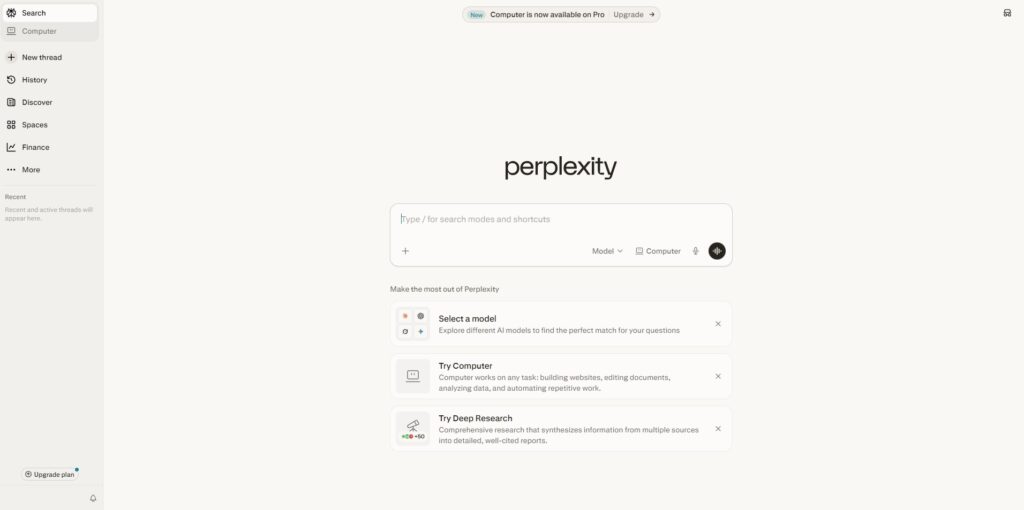
You type a question. Perplexity scans the web in real time, reads multiple sources, figures out what they agree on and where they conflict, writes you a clear answer in plain English, and attaches numbered citations to every claim.
The whole thing takes a few seconds.
Pro users get access to a “search focus” feature that lets you pre-filter where Perplexity looks before you even ask the question. Want real human opinions instead of SEO blog content? Set it to Social and it pulls from Reddit and forums. Need peer-reviewed research? Switch to Academic and it skips the marketing noise entirely.
That filtering capability is genuinely useful and most people sleep on it.
Key Features
Deep Research
This is Perplexity’s most impressive feature and the one that most directly threatens Google.
Deep Research runs dozens of searches simultaneously, reads through all the results, and produces a structured report with sourced claims, conflicting data flagged where it exists, and a clear through-line narrative. What would take a human research assistant a few hours to produce, Perplexity turns around in minutes.
It’s not perfect. The quality varies depending on the topic. For fast-moving subjects where sources contradict each other, the synthesis can get muddled. But for stable research topics, market research, and academic questions, it’s genuinely impressive.
Pro users get 20 Deep Research reports per day. Free users get limited access.
Spaces
Spaces are Perplexity’s version of project folders. You organize research by topic, and everything you search within that Space stays together. If you’re researching competitors, planning a trip, or tracking a story over time, Spaces keep it organized without you having to remember which thread had which answer.
It’s similar to ChatGPT’s Projects feature but more naturally suited to research since that’s what Perplexity is built around.
Multi-Model Access
This is one of Perplexity’s underrated strengths. Pro users don’t get locked into one AI model. You can choose from GPT-5.2, Claude Sonnet, Gemini 3 Pro, and Perplexity’s own Sonar and R1 models depending on what the task calls for.
The free plan uses Perplexity’s default model, which is solid but doesn’t give you the flexibility of model switching.
Source Filtering
Pre-filter your searches to pull from specific source types before you ask anything:
- Web (default, general)
- Academic (peer-reviewed papers only)
- Social (Reddit, forums, real human opinions)
- News (breaking and recent coverage)
- Video (YouTube sourced answers)
Perplexity Labs
Labs is Perplexity’s experimental workspace. Beyond research reports, it can gather multimedia assets, build custom charts and dashboards, create spreadsheets from research data, and generate visualizations. It’s part of Pro (limited queries) and unlimited on the Max plan.
Perplexity Computer: When It Stops Being a Search Engine
This is where Perplexity becomes something else entirely.
Launched February 2026, Perplexity Computer is not a search feature. It’s not even really a Perplexity feature. It’s a full autonomous AI agent that coordinates 19 different AI models simultaneously to plan and execute complex multi-step tasks on your behalf. You describe a goal. It figures out how to get there, breaks it into steps, calls on whichever models are best suited for each part, and executes the whole thing in the cloud without you babysitting it.
Think of it as Perplexity’s answer to Claude Cowork and OpenClaw. Same basic idea: AI that does work instead of just answering questions. The difference is how it’s packaged. OpenClaw is open source and requires a local setup. Claude Cowork is enterprise-focused and deep in the Anthropic ecosystem. Perplexity Computer is cloud-based, no setup required, and accessible to anyone willing to pay the $200 Max plan subscription.
That subscription gets you 10,000 monthly credits, access to the full 19-model suite including GPT-5.2 and Claude Opus 4.6, the Comet AI browser for web-based task execution, unlimited Labs usage, and Sora 2 Pro video generation on top of everything Computer can do.
The credit system is the thing to watch. Perplexity hasn’t published a per-task cost guide, which makes it genuinely hard to budget before you start a project. Early adopters report that complex multi-step tasks burn through credits faster than expected. The advice from people actually using it: start with well-scoped specific prompts, monitor the agent in real time until you know what you’re working with, and don’t hand it a vague brief and walk away.
Who is it actually for? Analysts, consultants, content producers, and researchers who are already juggling multiple AI subscriptions and want one place that handles research, analysis, writing, scheduling, and multi-tool coordination without the technical setup. If that’s you, the consolidated access might actually save money.
If you’re a developer who needs live previews, environment control, and visual feedback loops, Computer isn’t built for that. OpenClaw is still the better fit.
For a deeper look at how autonomous AI agents work and how they compare, check out our breakdown of OpenClaw and Claude Cowork.
Discover
A personalized news feed that learns from your search history and surfaces relevant updates across tech, science, culture, and business. More useful than it sounds once it’s been calibrated to your interests.
How Perplexity Performs in Real Tasks
Research and Fact-Finding
This is where Perplexity earns its reputation and it’s not close. For any task where you need current, verified, sourced information fast, Perplexity is the best tool available at any price point.
The source filtering alone changes how research feels. Being able to switch to Academic and get only peer-reviewed sources, or switch to Social and get actual human opinions from forums, makes the quality of information dramatically better than any general search.
One honest note: Perplexity can be slower than ChatGPT on long outputs because it re-checks sources as it writes. For complex research queries the tradeoff is worth it. For quick questions it can feel slightly sluggish compared to a pure chatbot.
Writing and Content Creation
This is the honest weak spot.
Perplexity can draft content but it’s not what the tool is optimized for. The writing output is functional but lacks the natural tone, sentence variety, and personality that Claude or ChatGPT produce. If you’re writing blog posts, marketing copy, newsletters, or anything that needs to sound like a human wrote it, Perplexity is not your tool.
Use Perplexity to research. Use Claude or ChatGPT to write. That combination is actually more powerful than either tool alone.
Coding
Perplexity handles basic coding tasks and is useful for quickly looking up syntax, debugging with sourced documentation, or understanding what a piece of code does. It’s not a coding-first tool and it doesn’t have anything like Claude Code for autonomous development work. For serious coding, Claude or ChatGPT are stronger choices.
Current Events and News Tracking
Strong. Because it pulls from the live web, Perplexity is genuinely useful for staying on top of fast-moving stories. The Discover feed adds another layer of personalized news curation. For anyone who uses AI to monitor industry news this is one of Perplexity’s clearest practical advantages.
Pros and Cons
| Pros | Cons |
|---|---|
| Real-time web search with citations | Weaker writing quality than Claude or ChatGPT |
| Source filtering (Academic, Social, News) | No image generation on free plan |
| Deep Research produces sourced reports | Limited conversational depth |
| Multi-model access on Pro | 5 deep searches per 4 hours on free |
| No ads (for now) | Mobile experience has friction |
| Spaces for organized research | Not built for coding workflows |
| Discover personalized news feed | Creative tasks are not its strength |
| Transparent, verifiable answers | Context memory less robust than ChatGPT |
Pricing and Plans
| Plan | Price | Best For | Key Inclusions |
|---|---|---|---|
| Free | $0 | Casual use, testing | Basic search, 5 deep searches per 4hrs, limited files |
| Pro | $20/month ($200/year) | Regular researchers, professionals | Unlimited deep searches, 20 daily Research reports, multi-model access, file uploads, image gen, Labs (limited) |
| Max | $200/month ($2,000/year) | Power users, agents | Everything in Pro, unlimited Labs, Perplexity Computer, full model suite, Sora 2 Pro video |
| Education Pro | $10/month (verified) | Students and faculty | Full Pro features at half price |
| Enterprise Pro | $40/seat/month | Teams | SSO, shared Spaces, admin controls, 500 daily research queries |
| Enterprise Max | $325/seat/month | Large orgs | Max features, highest compliance, audit logs |
Which plan makes sense?
Free is worth testing for a week before you pay anything. If you hit the deep search limit repeatedly and find yourself frustrated by it, Pro at $20 is an easy yes. If you never hit the limit, free is enough.
Pro is the sweet spot for anyone doing regular research, fact-checking, or information gathering as part of their work. The unlimited deep searches alone justify it if you’re doing more than a handful of research sessions per week.
Max at $200 is for a very specific user: someone who wants AI agent capabilities, wants everything in one place, and is willing to pay premium pricing for it. For most people the jump from $20 to $200 is hard to justify.
Free
$0
per month
5 deep searches / 4hrs
Basic model only
Limited file uploads
Pro
$20
per month ($200/yr)
Unlimited deep searches
GPT-5.2, Claude, Gemini
20 Research reports/day
Image + video gen
Max
$200
per month
Everything in Pro
Unlimited Labs
Perplexity Computer agent
Education
$10
per month (verified)
Full Pro features
Students & faculty only
Half the price
Perplexity Pro vs ChatGPT Plus vs Claude Pro: The Real Comparison
All three cost $20 a month. All three are worth considering. Here’s how they actually differ.
| Feature | Perplexity Pro | ChatGPT Plus | Claude Pro |
|---|---|---|---|
| Price | $20/month | $20/month | $20/month |
| Real-time web search | ⭐⭐⭐⭐⭐ | ⭐⭐⭐⭐ | ⭐⭐⭐ |
| Source citations | ⭐⭐⭐⭐⭐ | ⭐⭐⭐ | ⭐⭐⭐ |
| Writing quality | ⭐⭐⭐ | ⭐⭐⭐⭐ | ⭐⭐⭐⭐⭐ |
| Coding | ⭐⭐⭐ | ⭐⭐⭐⭐ | ⭐⭐⭐⭐⭐ |
| Image generation | ✓ (Pro) | ✓ DALL-E | ✗ |
| Voice mode | ✗ | ✓ | ✗ |
| Long document analysis | ⭐⭐⭐⭐ | ⭐⭐⭐⭐ | ⭐⭐⭐⭐⭐ |
| Deep research | ⭐⭐⭐⭐⭐ | ⭐⭐⭐⭐ | ⭐⭐⭐⭐ |
| Cross-session memory | Limited | ✓ | Projects only |
| Multi-model access | ✓ | ✗ | ✗ |
| Autonomous agent | Max only | ✓ Operator | ✓ Cowork |
| Ad-free | ✓ | ✓ | ✓ |
Perplexity wins for: real-time research, verified citations, source filtering, multi-model flexibility, news tracking.
ChatGPT wins for: image generation, voice mode, creative tasks, web browsing depth, memory across sessions.
Claude wins for: writing quality, long document analysis, coding, reasoning, UI mockups.
The honest answer: these three tools aren’t really competing for the same job. Perplexity finds things. Claude creates things. ChatGPT does a bit of everything but is the best at creative and conversational tasks. The best AI workflow in 2026 probably uses all three, which sounds expensive until you realize $60 a month for all three is less than most people spend on streaming services.
Who Should Use Perplexity Pro?
| User Type | Should They Use Perplexity Pro? | Why |
|---|---|---|
| Researchers and academics | ✓ Strongly yes | Academic filter, citations, Deep Research |
| Journalists | ✓ Strongly yes | Real-time news, verified sources, source filtering |
| Students | ✓ Yes ($10 with Education plan) | Academic sources, fact-checking, research reports |
| Content creators | ✓ Yes (for research phase) | Use to research, then write in Claude |
| Developers | Try free first | Not optimized for coding workflows |
| Casual users | Free is enough | Pro features only matter at high volume |
| Business analysts | ✓ Yes | Market research, competitor tracking, industry data |
Real Use Cases
The Competitor Research Workflow
You need to understand what a competitor is doing, what people think of them, and what gaps exist in their offering. In Google this is an hour of tab-juggling. In Perplexity: one Deep Research query, Social filter on for Reddit opinions, Academic filter on for any industry data. You have a sourced brief in under five minutes.
The “I Need the Answer Right Now” Search
Someone sends you a stat in a meeting and you need to verify it or contextualize it fast. Perplexity gives you the answer with the source in seconds. No clicking. No scanning. No wondering if the blog you landed on is credible.
Staying Current on a Fast-Moving Industry
Set up a Space for your industry. Use Discover for daily updates calibrated to your interests. Use Perplexity for any breaking development you need depth on immediately. This replaces a newsletter, a news aggregator, and a research tool with one subscription.
The Student Research Paper
Switch to Academic filter. Every source is peer-reviewed. Citations appear automatically. The Deep Research report gives you a structured overview of the literature you can use as a foundation before diving into the primary sources. Apple is opening Siri to competitors like this in iOS 27.
What Real Users Say
“It feels more like Google with superpowers. I stopped using regular Google for research about six months ago.” (Reddit, r/ChatGPT)
“The source filtering is what gets me. I set it to Social and I get Reddit threads and real opinions instead of SEO garbage.” (G2 reviewer)
“Weaker than Claude for writing but for finding things it’s not close. I use both.” (G2 reviewer)
Is Perplexity Pro Worth It?
If your work involves any meaningful amount of research, fact-checking, or information gathering: yes, obviously.
The free plan is genuinely useful for casual use. But the deep search limit on free hits fast if you’re doing serious research, and Pro at $20 removes that friction completely.
The bigger question is where it fits in your stack. Perplexity isn’t trying to replace Claude or ChatGPT. It’s trying to replace Google. And for research-heavy queries, complex multi-source questions, and anything where you need to verify the answer before you use it, it does that job better than Google does right now.
The combination that makes the most sense for most people doing serious AI-assisted work: Perplexity for research, Claude for writing and analysis, ChatGPT for creative and multimedia tasks. Three tools, three lanes, no overlap.
That’s $60 a month total.
For most people who use these tools to do better work, it’s probably the best $60 they spend.
Frequently Asked Questions
Is Perplexity better than Google? For complex research questions where you want a synthesized answer instead of links, yes. For simple lookups, local results, maps, and shopping, Google still wins. Most people end up using both for different jobs.
Does Perplexity have ads? Not yet. As of March 2026, Perplexity’s search results are ad-free. Whether that lasts as the company scales is an open question.
Can Perplexity replace ChatGPT? No. They’re built for different things. Perplexity is better for finding and verifying information. ChatGPT is better for creating content, coding, and creative tasks. Many people use both.
Is the free plan enough? For casual use, yes. If you’re doing more than a few research sessions a week you’ll hit the deep search limit and Pro becomes worth it quickly.
What models does Perplexity use? Free users get Perplexity’s default Sonar model. Pro users can switch between GPT-5.2, Claude Sonnet, Gemini 3 Pro, and Perplexity’s own R1 reasoning model depending on the task.
The Verdict
Perplexity Pro isn’t trying to be your AI assistant. It’s trying to be a better version of Google. And honestly? For that specific job, it’s winning.
The free version is good enough that most casual users will never pay a dime. But if you’re doing real research, fact-checking, tracking a fast-moving industry, or just tired of clicking through ten tabs to find one answer, $20 a month removes every friction point that makes the free tier annoying. Unlimited deep searches, model switching, sourced reports in minutes instead of hours.
The weaknesses are real and worth naming. It won’t write your content for you. It won’t replace Claude for analysis or ChatGPT for creative work. And the mobile experience has some rough edges. If you’re looking for a single AI tool to do everything, this isn’t it.
But that’s not the right frame. The right frame is this: what’s your research workflow worth to you? If the answer is more than $20 a month, Perplexity Pro is a no-brainer.
Use it to find things. Use Claude to build things. Use ChatGPT when you need images or voice. That combination beats any single tool at any price point.