










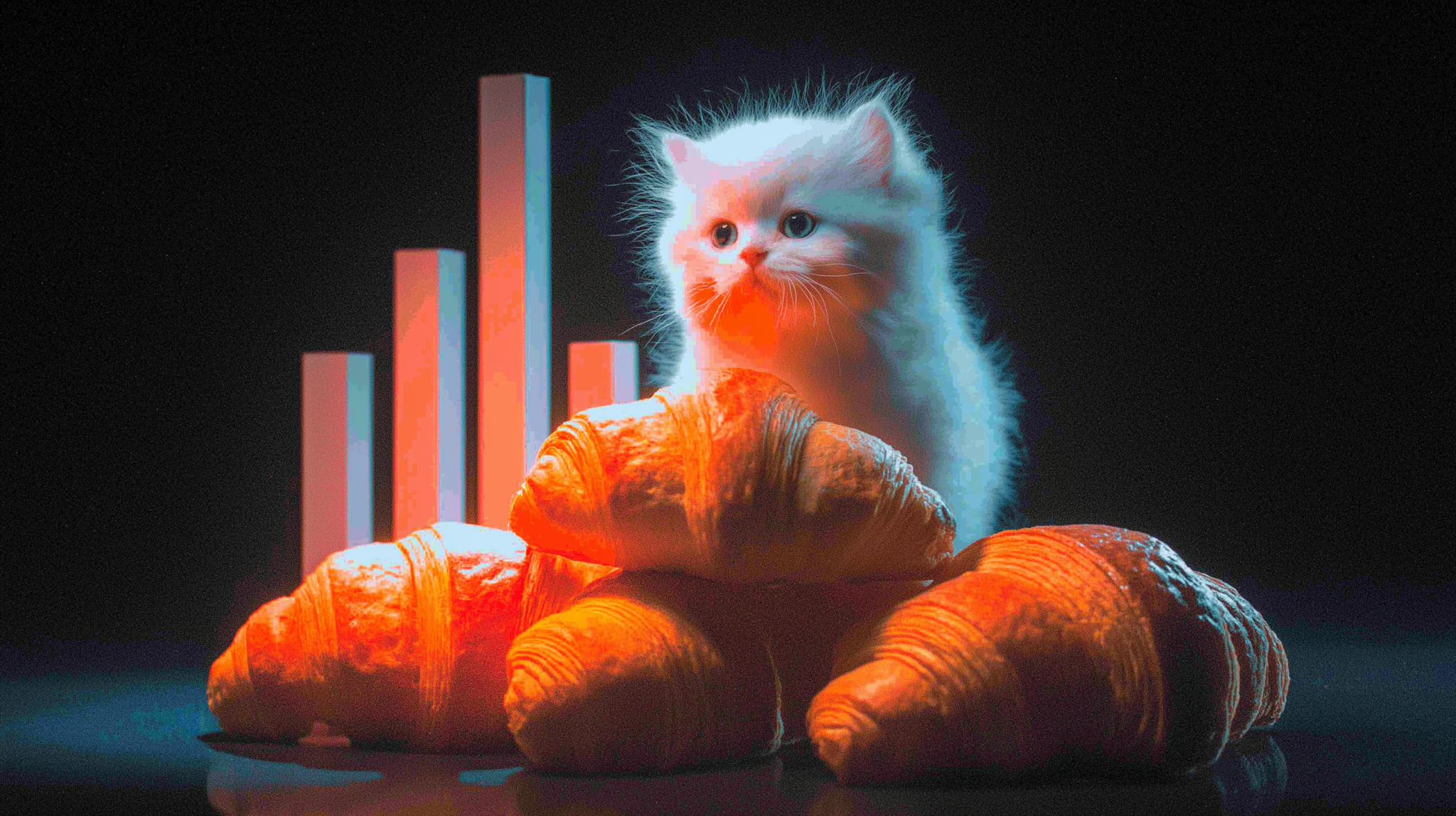
Le Chaton Fat was a fake Mistral AI model that went viral on X and Reddit between June 11 and 17, 2026. It started after Mistral renamed its Le Chat chatbot to Vibe at a Paris summit. Fans revolted, and the internet invented a “fat kitten” successor as a tribute. Within days, meme accounts had fabricated benchmark charts showing the fictional cat hitting 30 trillion parameters and beating Anthropic’s Fable 5. One even listed a context window labeled “infinity (for croissants).”
Then it stopped being obviously a joke. Researchers at named labs were genuinely unsure. One Arcee AI researcher publicly asked if it was real, briefly believed it, then apologized. Mistral’s own CEO joined in, “correcting” everyone that the model was actually called Le Gros Chaton. Wharton’s Ethan Mollick said the gag had leaked to corporate executives. A Solana memecoin spawned off it. The joke landed because two things are true in 2026. AI benchmark culture is so inflated that absurd fake numbers look normal. And the US had just banned Anthropic’s models, leaving people hungry for a European AI nobody could switch off.
Best for anyone who wants the full story, plus the serious point hiding inside the joke about why AI benchmarks barely mean anything. Not ideal for readers looking for a real model review, because the model is a cartoon cat.
For about a week in June, some of the smartest people in AI were quietly asking each other a deeply stupid question.
Is the fat cat real?
It was not. The fat cat was a cartoon. But the fact that serious researchers entertained the question, even for a few hours, is the most revealing AI story of the month. More revealing than any actual launch.
How a Rebrand Spawned a Cat
The whole thing started with a real corporate decision. At Mistral’s first summit in Paris, CEO Arthur Mensch announced the company would rename its consumer chatbot. Le Chat, French for “the cat,” was becoming Vibe.
Plenty of users were not happy about losing the cat. Reddit threads filled with mock tributes and increasingly elaborate feline successors. The one that stuck was a round, smug, white cartoon kitten dubbed Le Chaton Fat, a bilingual pun that lands as “the fat little cat.” It was charming enough to screenshot. So people screenshotted it.
Then, as the internet does, it started iterating. And iterating is where the joke turned into something stranger.
The Benchmarks Got Absurd, Then Believable
On June 11, a parody benchmark chart began circulating on X. It showed the plump white cat topping a leaderboard with numbers no real model has ever claimed. There was 100 trillion parameters, a score thirty points above Fable 5 on something called “VoltaireBench,” and a context window labeled “infinity (for croissants).”
The original chart was obviously satire. The specs were deliberately ridiculous, aimed squarely at AI benchmark inflation culture. But the internet kept escalating. Later versions claimed 30 trillion parameters, “256 experts,” “1000 meows per second,” and a 9.24 TiB download size. Meme accounts built fake launch posts, fabricated regulatory notices declaring the model “too heavy to regulate,” and mock EU compliance filings.
Here’s the part that matters. Somewhere in the escalation, the fake stopped being obviously fake. Per Business Insider and Digg’s reporting, Mistral itself reportedly posted then deleted a satirical announcement. It named the fictional model at 24 trillion parameters. When the company that supposedly built the thing plays along, the line between joke and press release dissolves completely.
When Researchers Couldn’t Tell
This is where it goes from funny to genuinely interesting.
By June 12, the replies had split into three camps. There were people who knew it was satire, people who were unsure, and people who were certain it was real and furious they couldn’t access it because of EU export controls. That second camp included people who should have known better. Cody Blakeney, a researcher at Arcee AI, tweeted the question directly: was Le Chaton Fat real or an elaborate joke? He then briefly convinced himself it was real and blamed export controls for his lack of access. Later he circled back to apologize for asking “such a silly question.” Researchers at named labs were reportedly DMing each other the same question.
Then Mensch poured fuel on it. Mistral’s CEO replied to the chaos by “correcting” everyone, insisting the model was actually called Le Gros Chaton, which translates to the same thing. A company joking along with a fake version of itself is rocket fuel for a meme. By mid-June it had outgrown the AI bubble entirely. Wharton professor Ethan Mollick noted the gag was leaking to the outside world. He joked he expected corporate leaders to start asking him about Mistral’s giant cat model. Replit’s CEO quipped that the fake cat was preferable to Anthropic’s actual models.
A week after it started, a Solana memecoin called CHATON spawned off the trend, riding the name with zero connection to Mistral, because of course it did. The fictional cat now had a fictional token.
The Critique Hiding Inside the Joke
Strip away the cartoon and Le Chaton Fat was making an argument the AI community absorbed precisely because it stung. Three real problems got exposed by a fake cat.
Benchmarks mean almost nothing. A model can top a leaderboard most people can’t name, on tasks nobody ships to production. And the announcement gets treated as a major event. The fake cat’s “30 points above Fable 5 on VoltaireBench” looked just like real launches. They tout victories on benchmarks that don’t map to anything you’d actually use. When the satire is the same shape as the real thing, the real thing has a problem.
“Confirmation” has broken as a concept. A CEO reply that’s clearly a joke read as product confirmation. A parody spec sheet, if precise enough, became indistinguishable from a real announcement. The gap between satire and press release has collapsed almost completely. The normal verification instinct, checking whether a frontier lab’s CEO acknowledged it, actively pointed people toward the wrong answer.
And the timing exposed something real about the moment. The meme caught fire days after the US government restricted access to Anthropic’s Fable 5 and Mythos 5. The ban blocked all non-US users worldwide. That left people genuinely hungry for an open European alternative nobody could switch off. A fictional unbeatable French model that the EU couldn’t even regulate wasn’t only funny. It was wish fulfillment for a community that had just watched Washington flip a kill switch on the most powerful models on earth.
What Mistral Actually Is Under the Cat
Behind the cat memes, Mistral is a real company with a real product line, and the gap between the joke and the reality is its own kind of story. Its chatbot is now Vibe, and it ships genuine open and commercial models. None of them has 30 trillion parameters. None outputs exclusively French code. None requires you to be outside the EU.
The meme worked partly because it exaggerated a promise Mistral genuinely makes. Mensch has spent years warning against leaving “the keys” to your AI in another country’s hands. The company is reportedly raising billions at nearly double its last valuation on exactly that sovereignty pitch. France recently dropped Palantir from an intelligence agency and plans to give civil servants Mistral-powered assistants. The “AI nobody can switch off” fantasy that Le Chaton Fat embodied is the actual marketing thesis. It just leaves out the 30 trillion parameters.
But sovereignty solves control, not quality. Mistral’s models are solid and open. They are not yet the frontier. Studies show some open-weight models, including Mistral’s, struggle more than closed models to filter disinformation. Being the model nobody can switch off doesn’t make it the best or the safest. It just makes it yours.
The Test the Cat Left Behind
The most useful thing to come out of a week of cat memes is a genuinely good habit. Next time a “frontier model” trends with jaw-dropping benchmarks, run the Le Chaton Fat test. Are there weights? Is there an API? Are there docs? If the answer is no weights, no API, no documentation, just a chart and some hype, then it is probably a kitten.
That sounds like a joke, and it is, but it’s also the most honest verification standard anyone’s proposed for AI launches this year. The reason a cartoon cat fooled researchers is simple. Real launches increasingly arrive as exactly that: a chart, a benchmark claim, a CEO tweet, and a wave of hype. The actual shippable thing arrives later, if at all. Le Chaton Fat didn’t break that pattern. It just removed the part where a real model eventually shows up.
For one week in June, the AI industry got pranked by its own worst habits. The funniest part isn’t that a fat cartoon cat went viral. It’s that the only thing separating it from a real announcement was a download link. For a few days, even the experts couldn’t be sure that was missing.